STAR-PHASER GALAXY
GALAXY is QLT's first photonic system whose native symbol algebra is a finite field — GF(16) = GF(2⁴) on a 16-bin frequency-qudit carrier at Δf = 50 GHz and Bcomb = 750 GHz. Still firmly in STAR-PHASER Region I (linear QFP + distributed OPC, Q < 0.2), today-feasible because every block reuses the demonstrated decit stack scaled 10→16, and it is the deliberate stepping stone between SOLAR's structured ℤ₁₀ composite and the mature GF(64) endpoint — while doubling as the QUASAR-transition prototype that rehearses Region II materials without crossing the Q≈0.2 boundary in v1.
First clean field architecture in Region I
From ℤ₁₀ decimal structure to algebraically closed GF(2⁴).
STAR-PHASER lineup
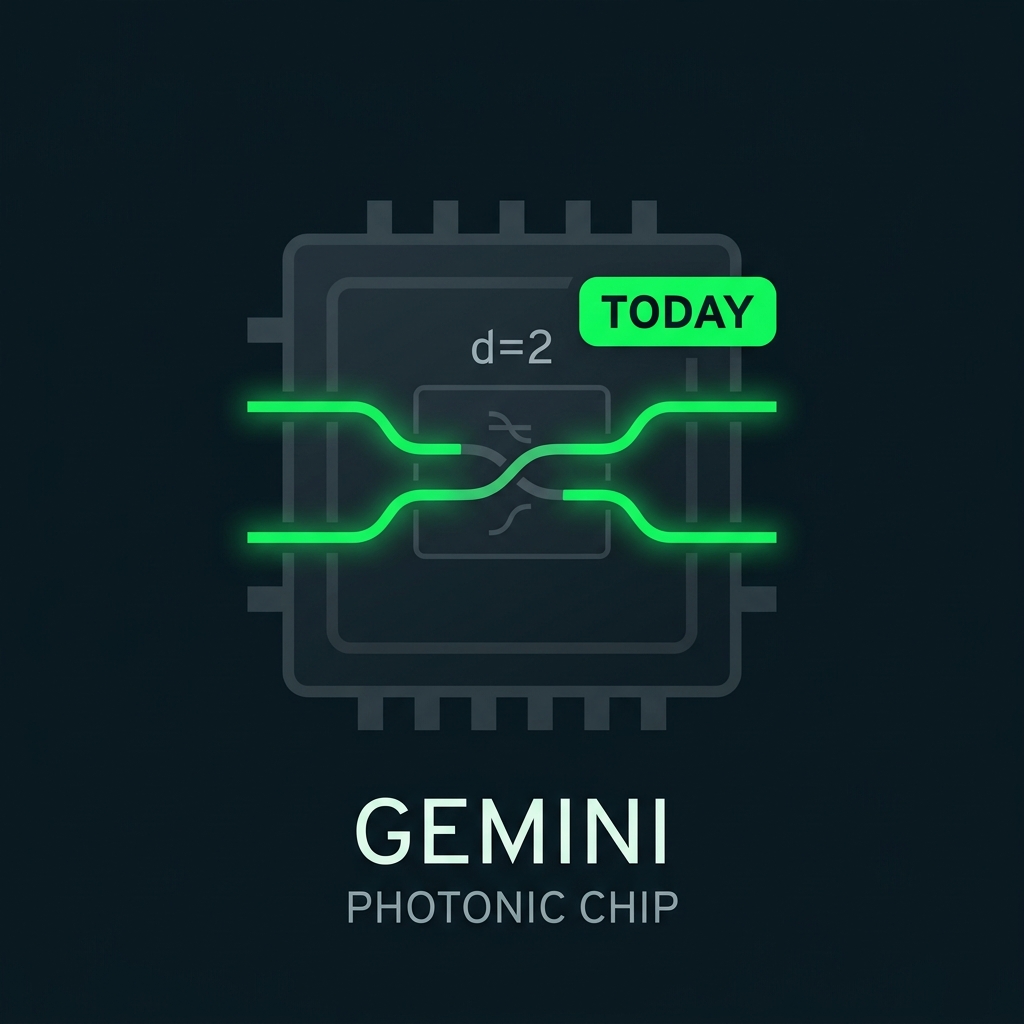
GEMINI → SOLAR → GALAXY → TETRIS → NOVAGEMINI — d=2, GF(2) dual-rail
→v1 shipping product. Path-encoded qubit on Si₃N₄; measurement-based fusion; single-node OPC hygiene. Product is dual-rail path encoding — not frequency-bin field ISA.
d=2 · Region I · TODAY
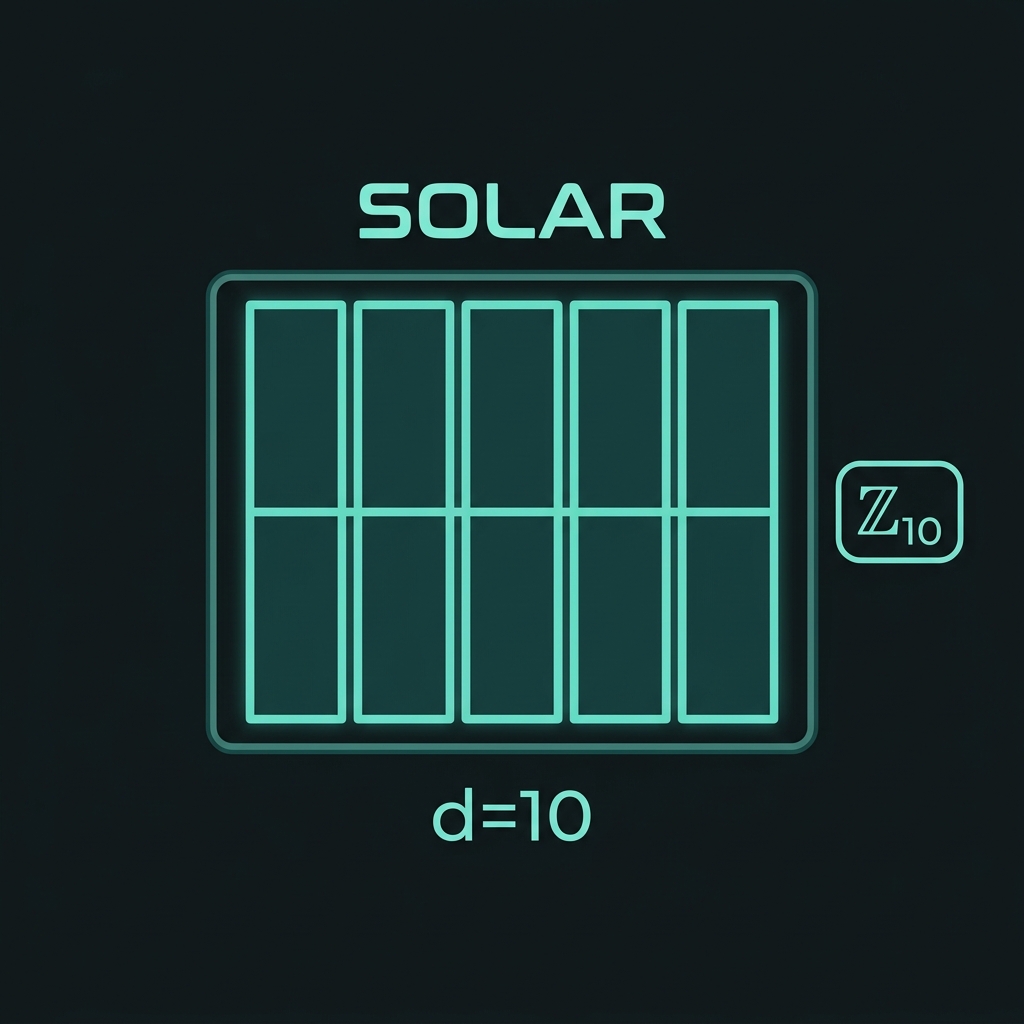
SOLAR — d=10, structured composite
→Human-readable decimal: 2×5 tensor-product subspace with ℤ₁₀ addition — convenient for symbolic encoding, not a field (5 has no inverse mod 10). Not algebraically closed.
d=10 · ring, not field · Region I
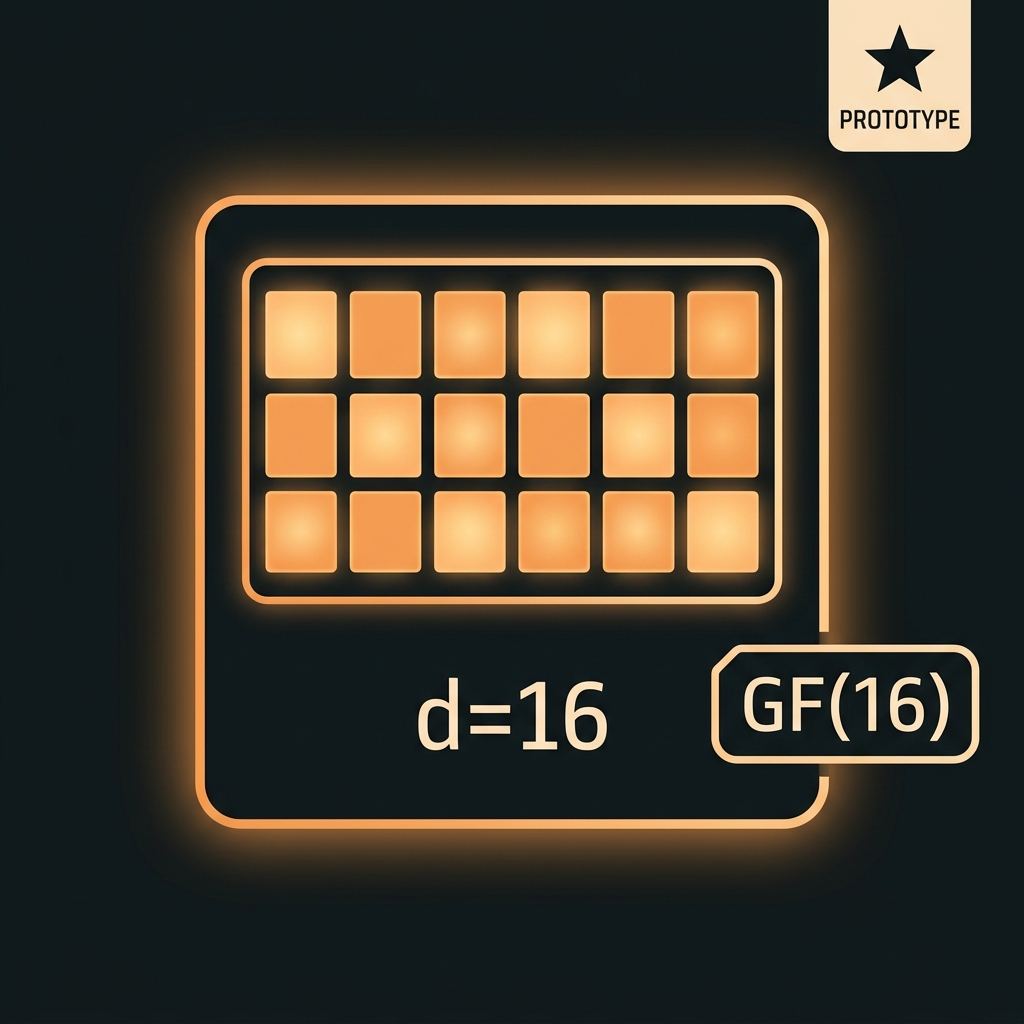
GALAXY — d=16, first true GF system
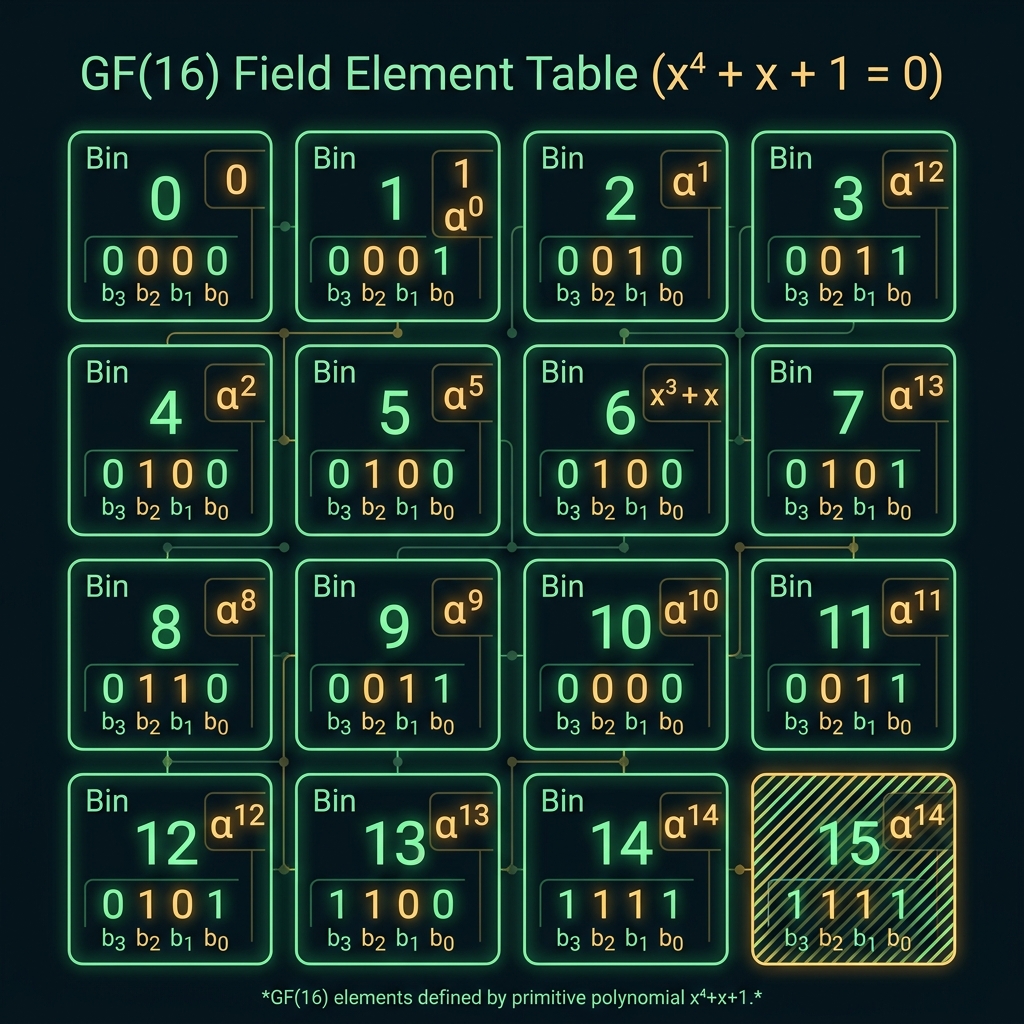
→Sixteen mutually coherent frequency bins labeled as GF(2⁴) elements. Addition = XOR on 4-bit polynomial coefficients; multiplication = polynomial multiply mod primitive irreducible p(x) = x⁴ + x + 1. Every nonzero element has an inverse.
Hero claim: GFADD/GFMUL kernels, RS(15,11) syndrome arithmetic, and X₁₆/Z₁₆ stabilizer Paulis become first-class ISA primitives — not transcoder hacks on decimal.
4 bits/photon · 750 GHz · Q ≈ 0.08–0.15 · roadmap
NOVA — d=64, Region II endpoint
→Optimal balance chip; 8×8 octet tiling at full scale; GALAXY's dual-octet layout is the genesis step. GALAXY QUASAR-transition prototype rehearses NOVA materials at d=16.
d=64 · Region II · WS12 synthesis
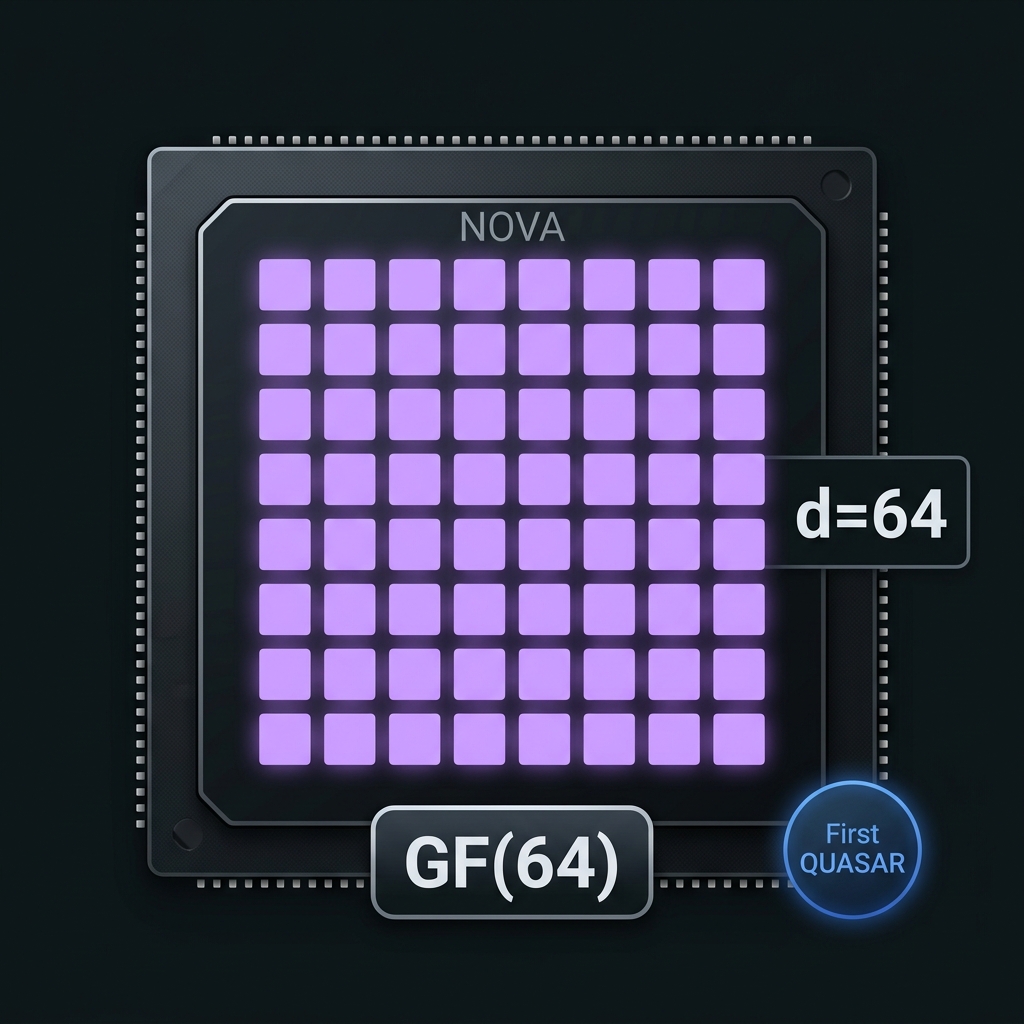
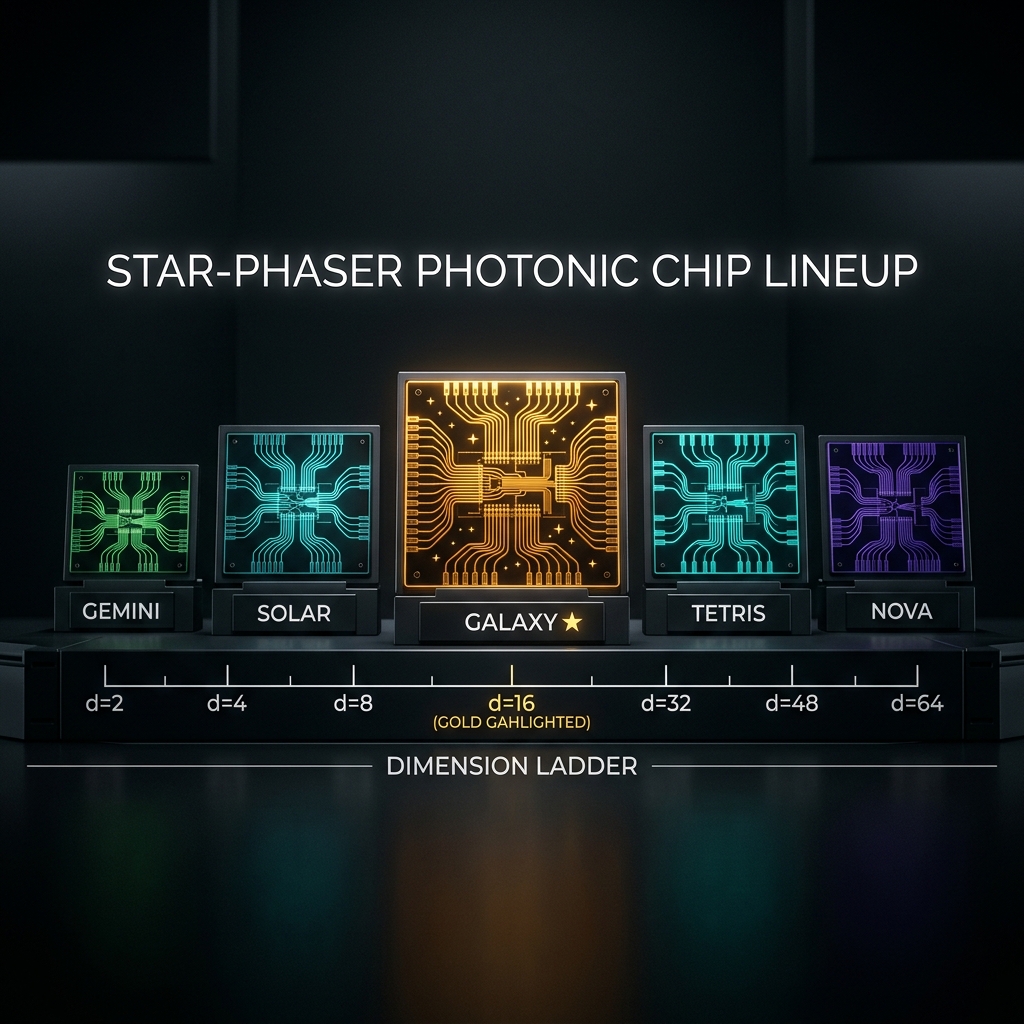 Figure 1
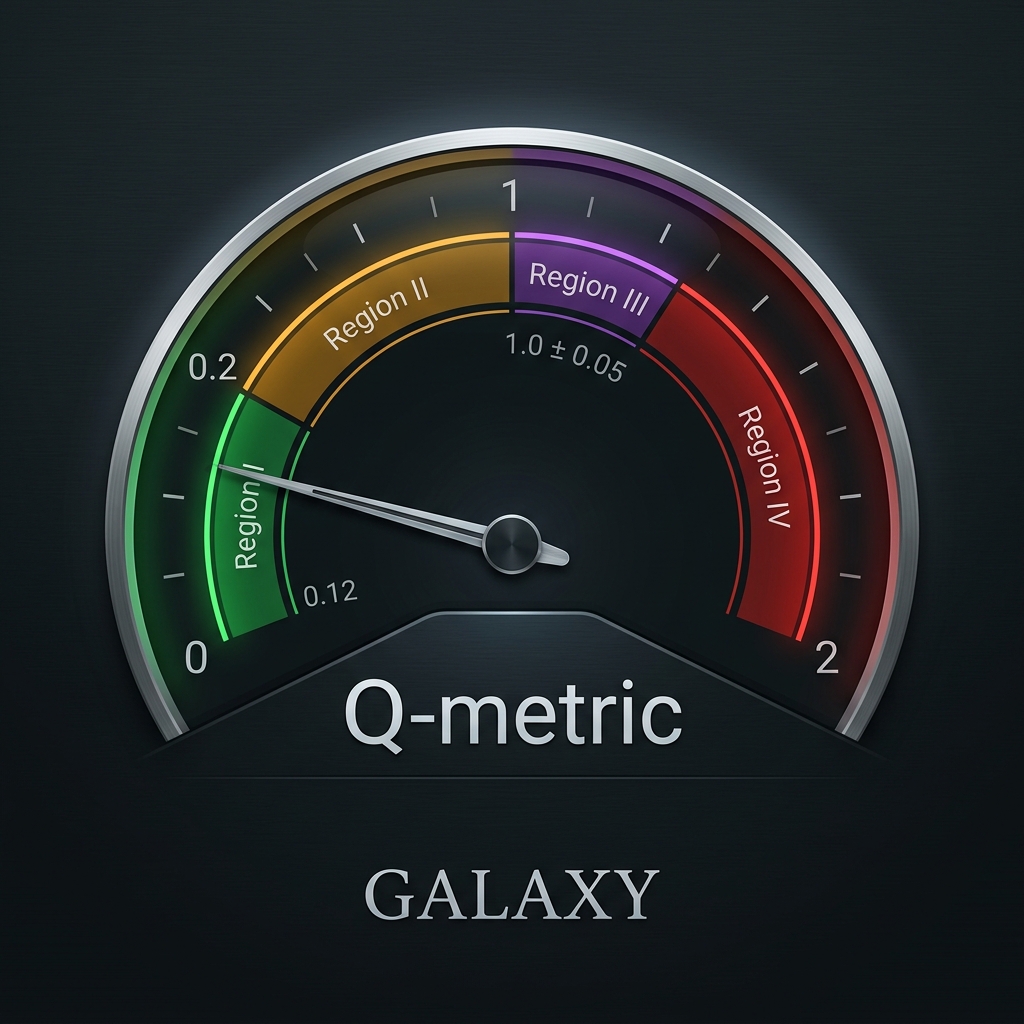 Figure 2
d = 16 = 2⁴
4 bits per photon in Hilbert space; 4 GF(2) coefficient bits per field element in polynomial basis.
Δf = 50 GHz
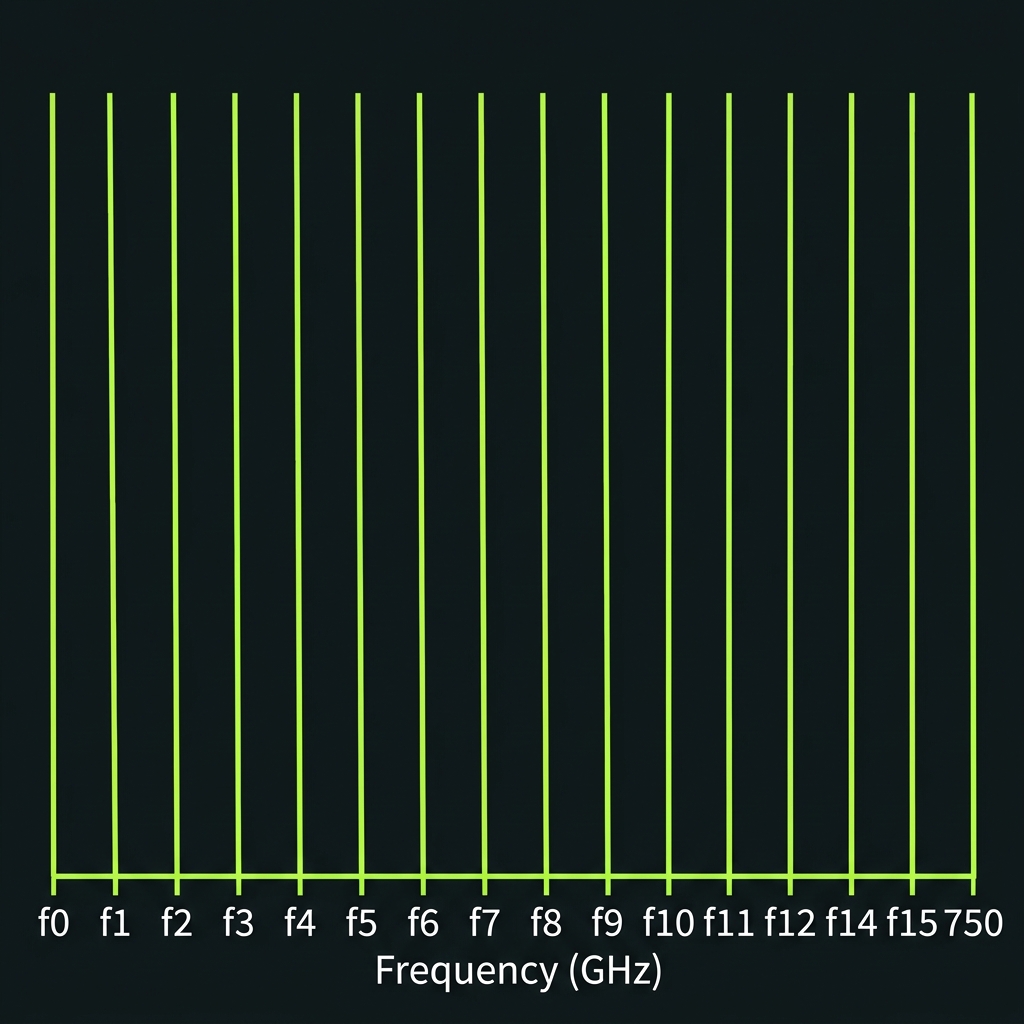
Bcomb = 750 GHz = 15·Δf. C-band telecom-native; AWG-precedented spacing.
~5×7 mm² die
Three co-integrated tiles — source, QFP/FAU, readout — scaled from B07 decit tile.
16-bin lattice & GF(16) spectral map
One photon, sixteen colors — Hilbert dimension and finite-field arithmetic coincide by design.
Spectral commitments
Lattice · labeling · orthogonality · OPC margin|ψ⟩ = Σ c_n |f_n⟩, n = 0…15
→f_n = f_ref + n·Δf , Δf = 50 GHz , Σ|c_n|² = 1
Coefficients are amplitudes over GF(16)-labeled bins. Quantum superposition is distinct from classical GF(16) addition implemented by FAU interference.
How we do it: All sixteen teeth descend from one pump via SFWM — mutual phase coherence at birth [demonstrated, B02].
|f_k⟩ ↔ α^k, k = 0…14
→Primitive polynomial p(x) = x⁴ + x + 1. Computational basis = exponential/log basis (native for RS roots). Polynomial basis for XOR-add via F₁₆ QFP rotation.
Guard bin f₁₅: reserved — α¹⁵ = α⁰ degeneracy isolation; monitor or RS zero [designed/target]. Active compute window: bins 0–14.
Orthogonality & linewidth targets
→Adjacent-bin overlap F_orth ≥ 0.999 after shaper windowing. Per-bin linewidth δν = 0.19–1.9 GHz (Q=10⁵–10⁶); Δf/δν ≥ 26. Crosstalk budget ε ≤ 1% per neighbour.
OPC compatibility: 750 GHz ≪ 12 THz claimed FWM band → one OPC pass conjugates all sixteen bins coherently.
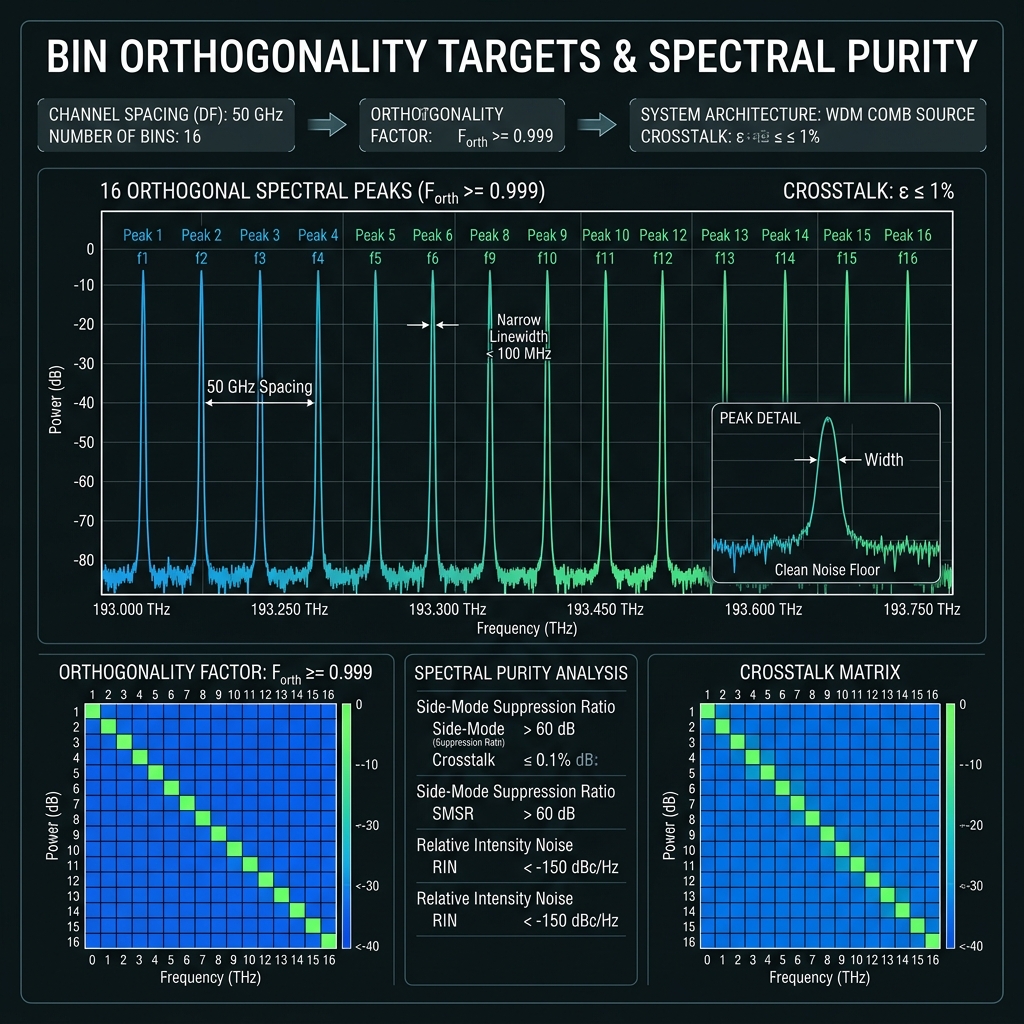
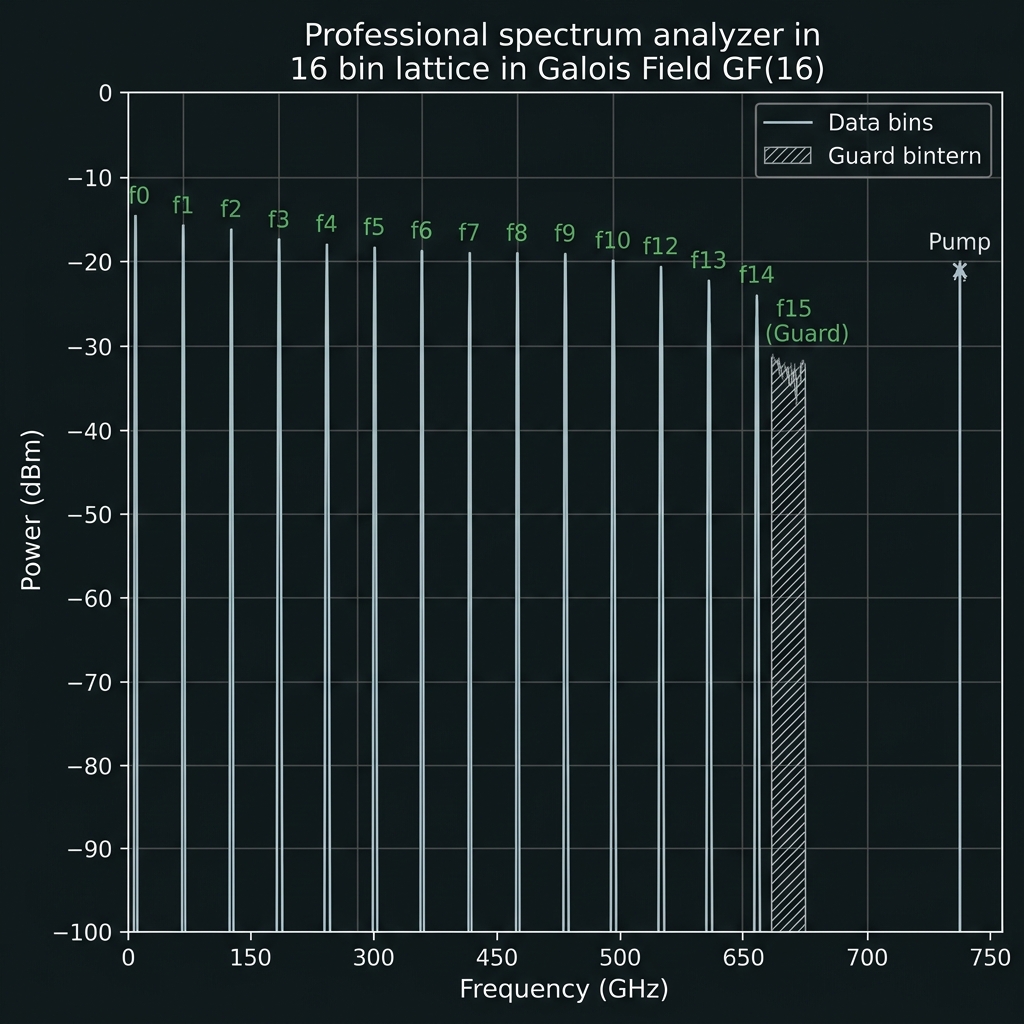 Figure 3
SU(16) QFP & GF(16) named primitives
First chip where GF arithmetic and SU(d) quantum gates share one QFP stack.
{X₁₆, Z₁₆, F₁₆, BS₂}
| X₁₆ | |n⟩ → |n+1 mod 16⟩ | 1 stage |
| Z₁₆ | |n⟩ → ω^n|n⟩ | 1 stage |
| F₁₆ | DFT₁₆ / field FFT | 6–10 stages |
| BS₂ | 2-bin Hadamard | 1 stage |
GFADD · GFMUL · GFINV · GFMAC
| GFADD | XOR on 4-bit poly | 1–2 depth |
| GFMUL | Log/antilog or F-basis conv | 2–4 depth |
| GFINV | α^k → α^{15−k} | 1 (table) |
| GFMAC | Parity accumulate | 3–6 depth |
Tiering: Tier A (production) = named generators + FAU only. Tier B (calibration) = offline Reck SU(16). No runtime arbitrary unitaries in QEC hot loop. Harmonic RF bus: tones m·Δf, m=1…8 on 0.8–1.2 cm TFLN traveling-wave segment.
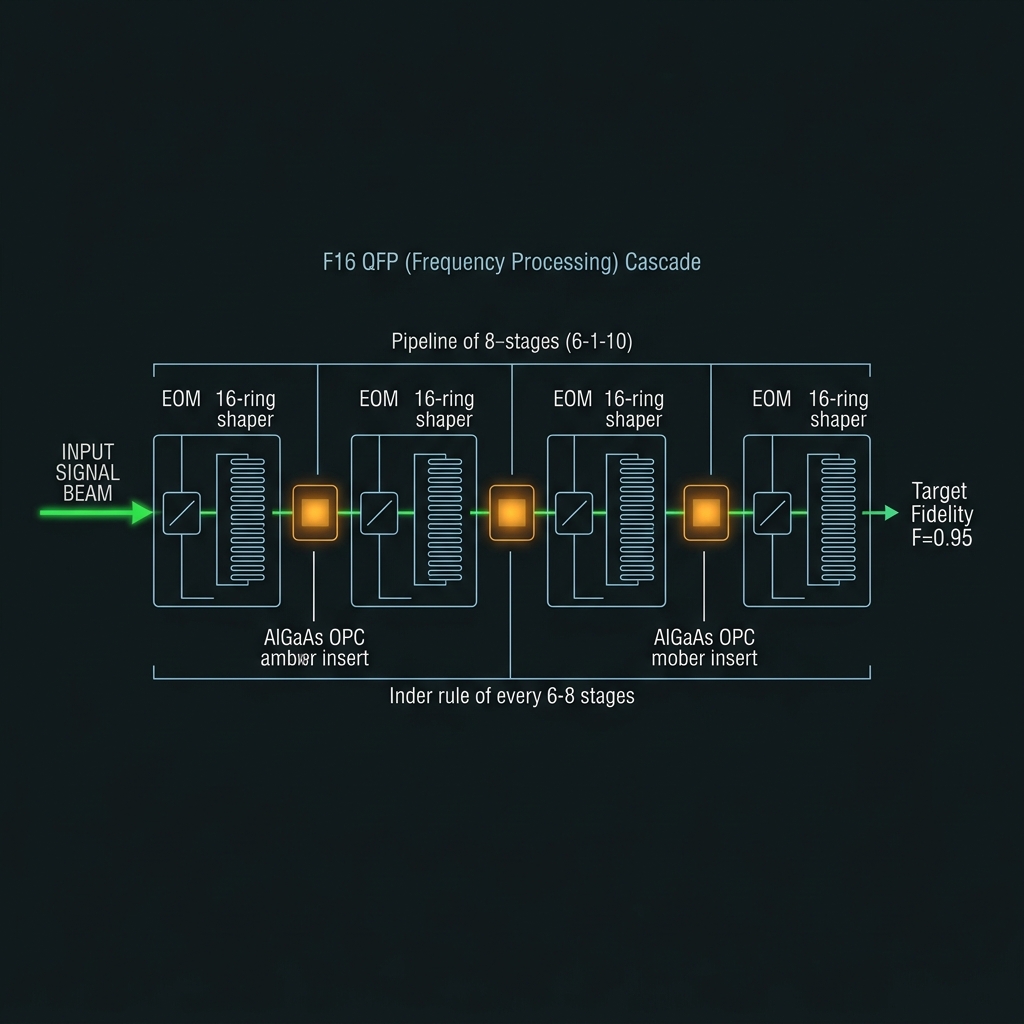 Figure 4
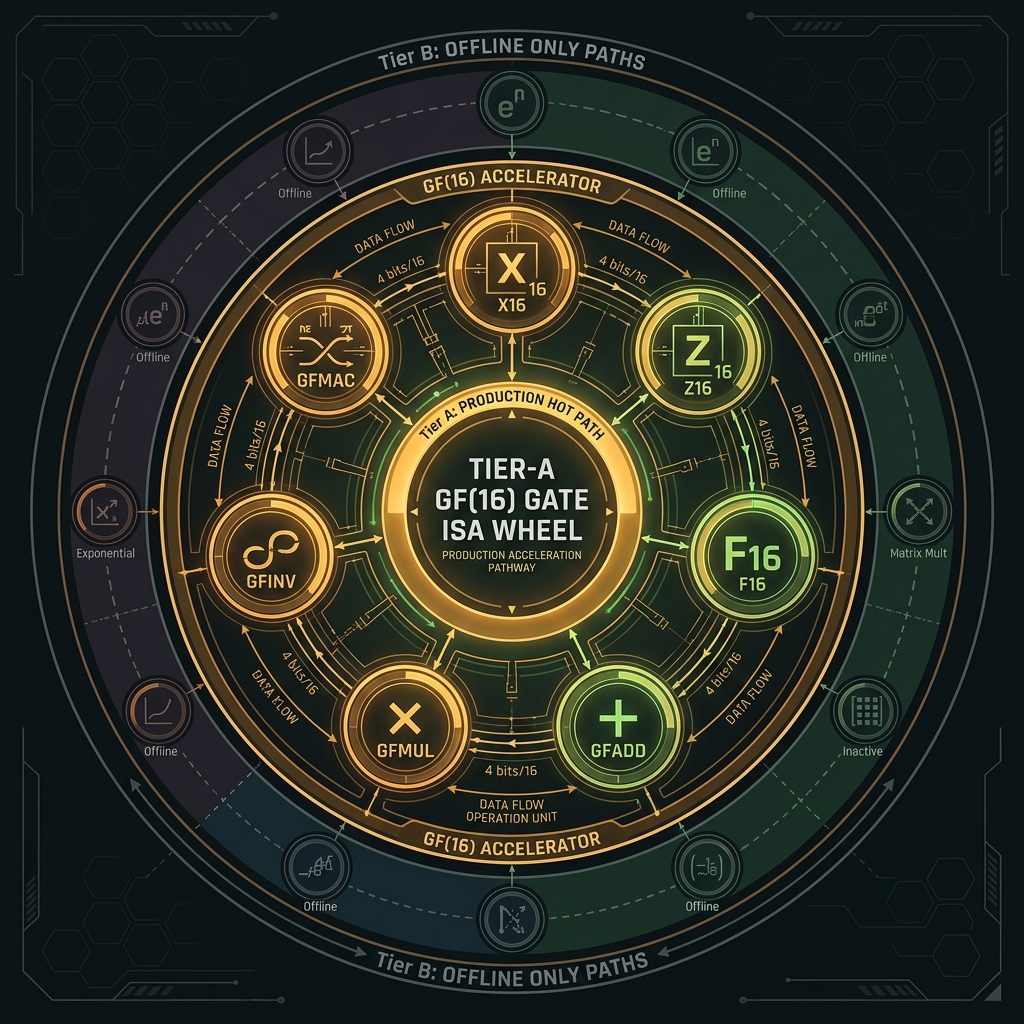 Figure 5
16-line comb & dual-octet tiling begins
Scaled decit tile — not a new materials story.
Three-tile floorplan
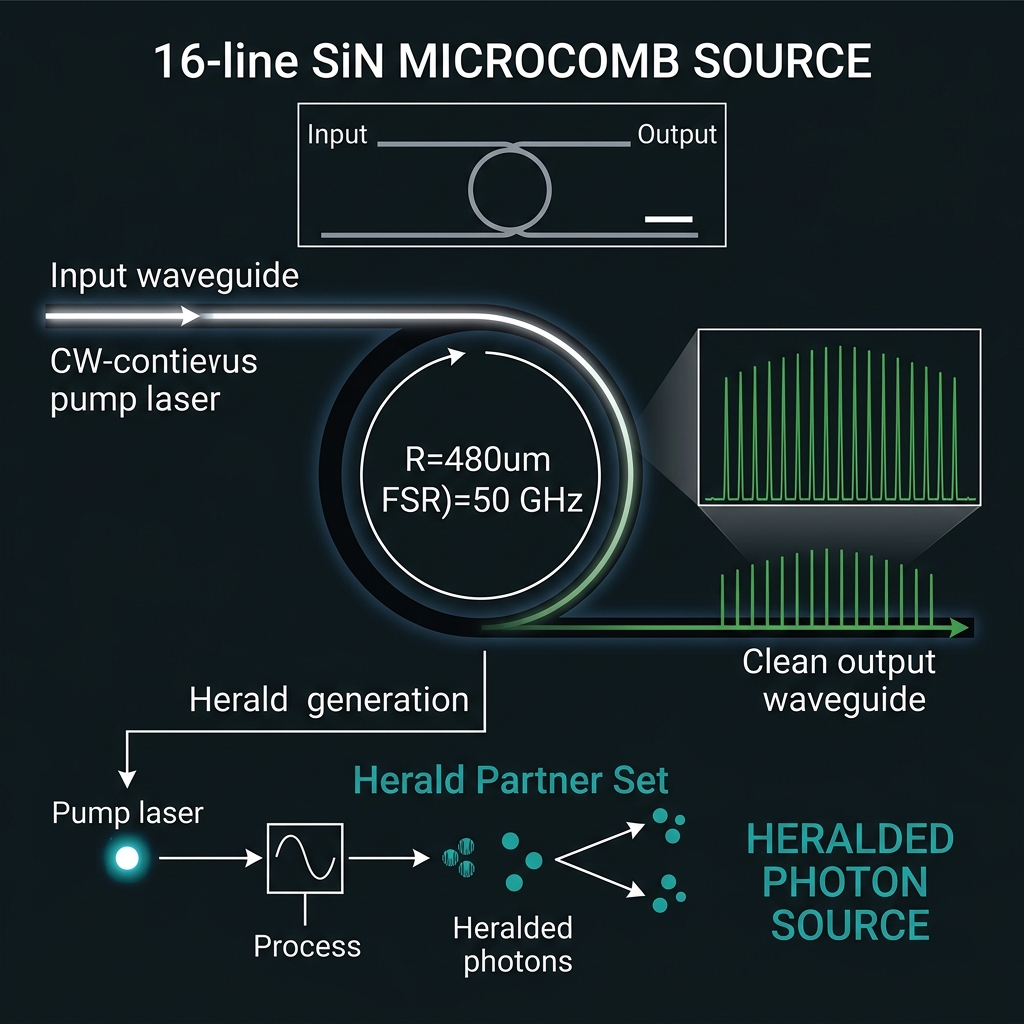
SOURCE · QFP/FAU · READOUT · ~5×7 mm²16-line SiN microcomb @ 50 GHz
→Route A (primary): SFWM ring R ≈ 480 µm (FSR ≈ 50 GHz), Q_loaded 10⁵–10⁶, 16 signal teeth + heralding partner set. Route B (fallback): EO sideband comb — R≈50 µm seed + TFLN harmonics.
How we do it: Pump rejection ≥110 dB; f_p placed ≥2Δf outside nearest compute bin.
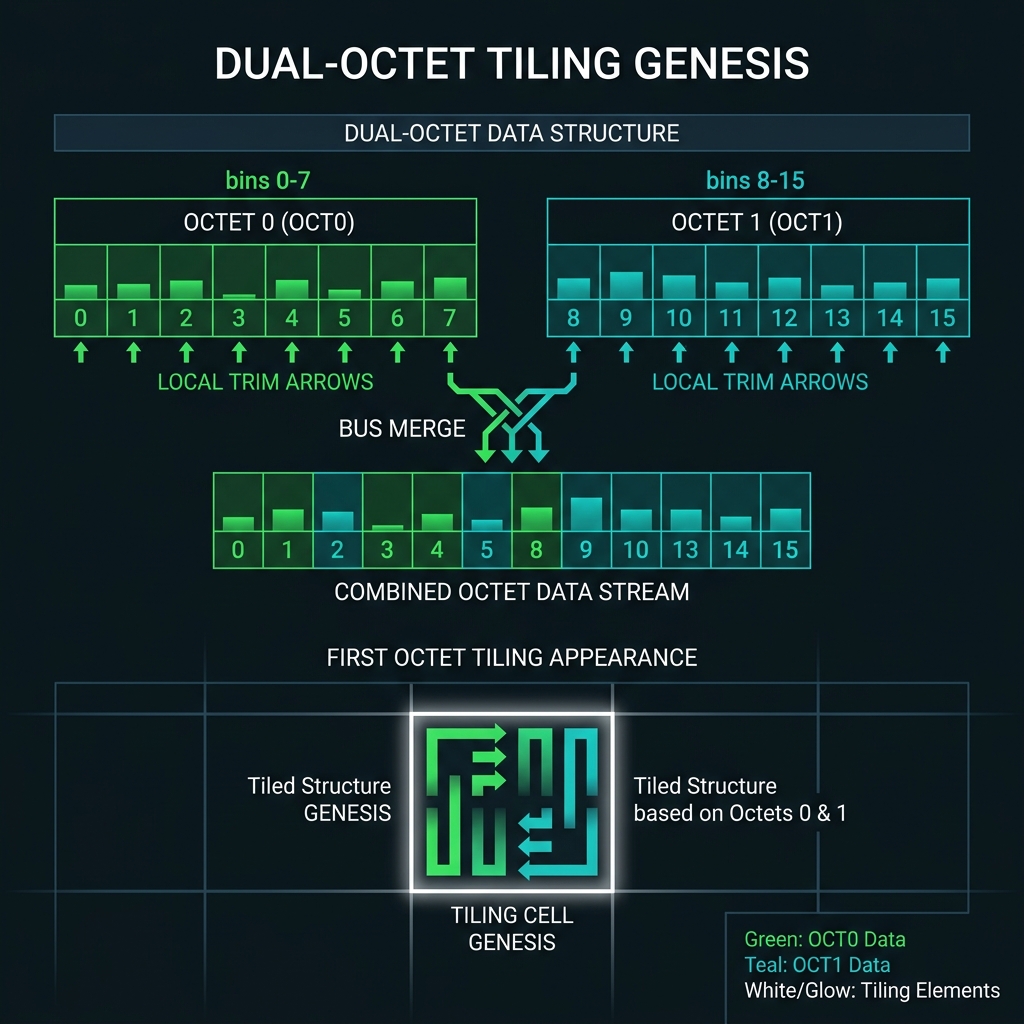
Dual-octet shaper tiling
→OCT0: bins 0–7 ── local trim ──► bus OCT1: bins 8–15 ── local trim ──► bus
First appearance of octet tiling — scales to G46 eight-octet NOVA. Trade: +1.5 dB router loss vs monolithic; gain: parallel bring-up, yield per octet.
Scale-up from decit tile
→+6 shaper rings, +6 WDM channels, +2 octet trim loops vs B07. Heater DAC ~32–40 channels. AlGaAs BEOL overlay for 2–3 distributed FWM-OPC cells (QUASAR-transition).
How we do it: Retarget B07 GDS — duplicate 8-ring octet cell; AlGaAs windows post-TFLN, pre-cap.
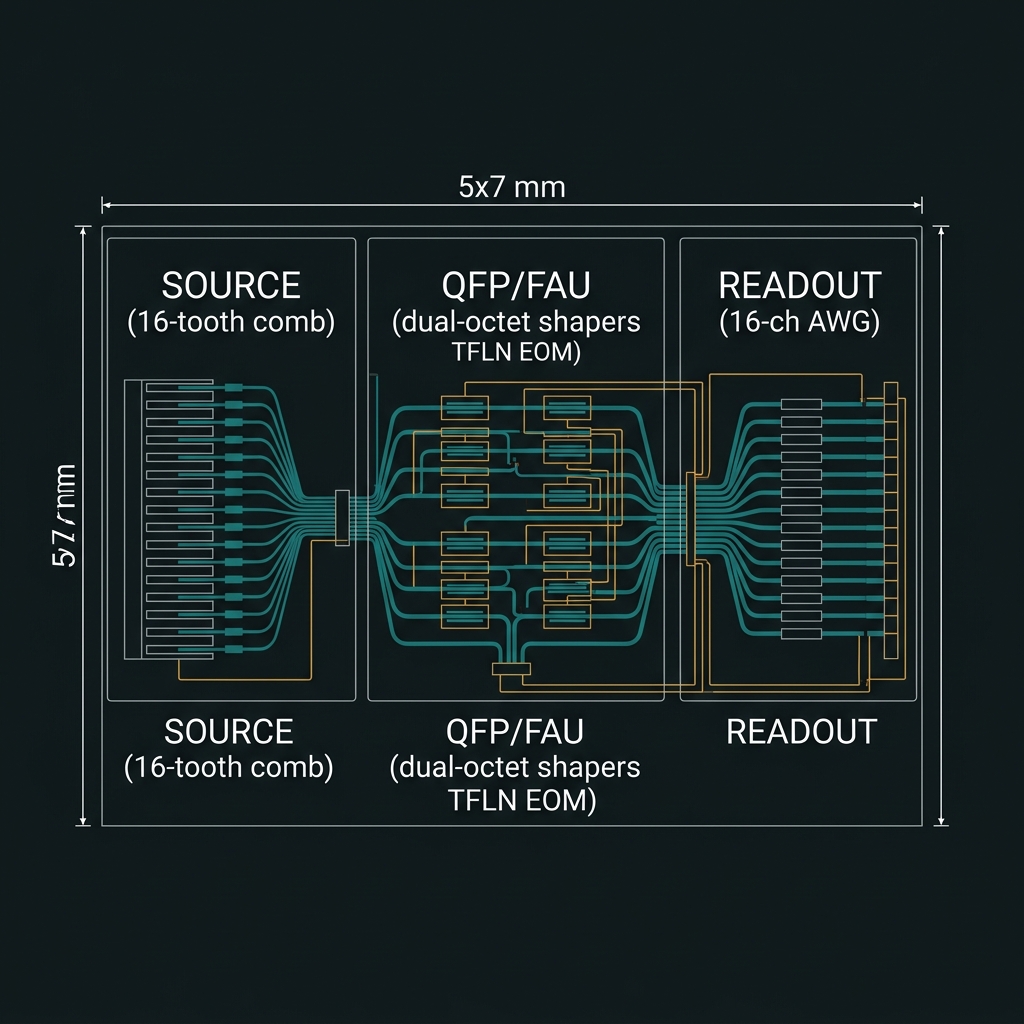
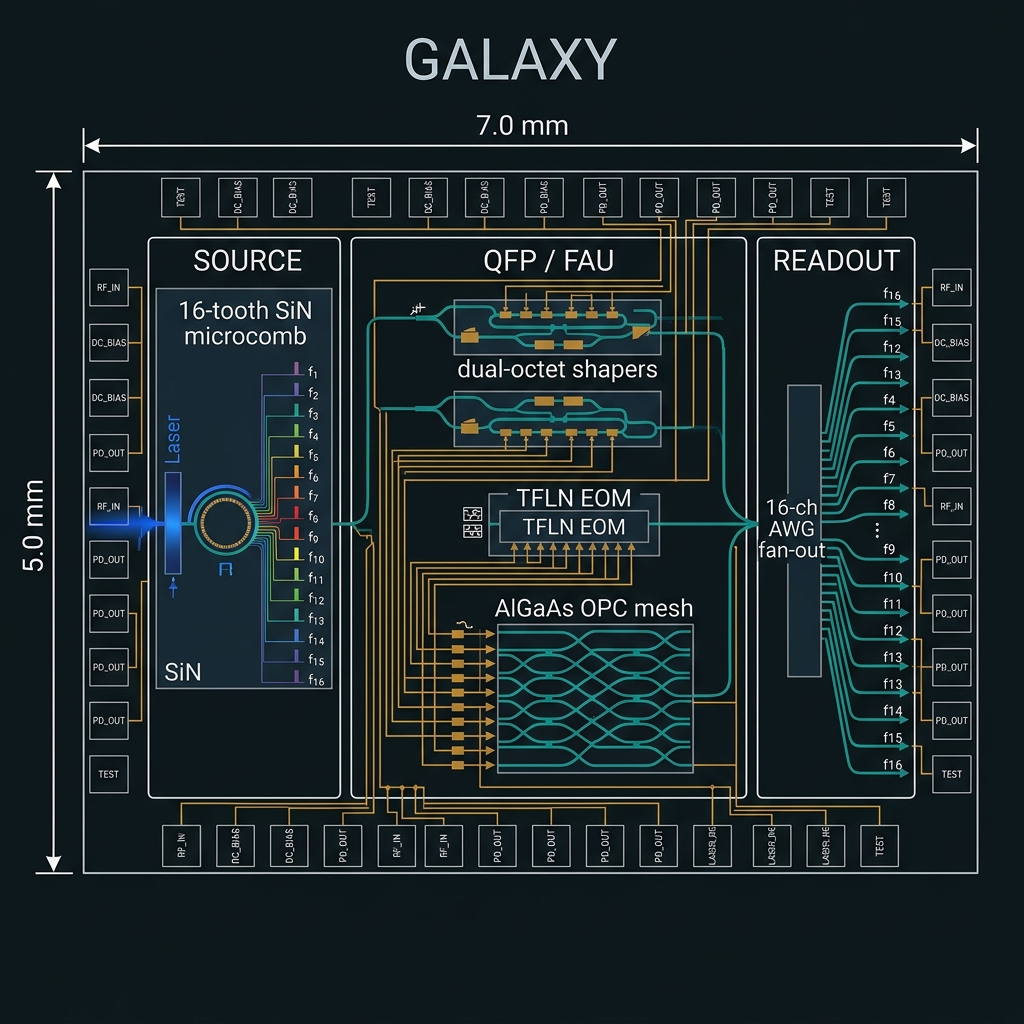 Figure 6
16-channel WDM — first GF readout
Every detector channel maps to a field element, not a decimal digit.
16-ch AWG baseline
50 GHz spacing; ≤−20 dB adjacent crosstalk; ≤4 dB IL. v1 baseline [designed/target].
16-ring cascade
Serial bus + add-drop rings; tunable grid fallback when AWG yield fails.
2×8 octet mini-AWG
OCT0/OCT1 each 8-ch; matches S24 tiling; +1.5 dB router.
Readout fidelity [model]: single-stage AWG ε=1% → F_read ≈ 0.981; cascaded −30 dB → ≈0.998. Product mode: 16 SPAD single-shot GF(16) computational read. Bring-up: 1–2 SNSPD serial scan with project-then-detect [B09]. Non-computational basis (MUB/F₁₆): QFP rotation before demux.
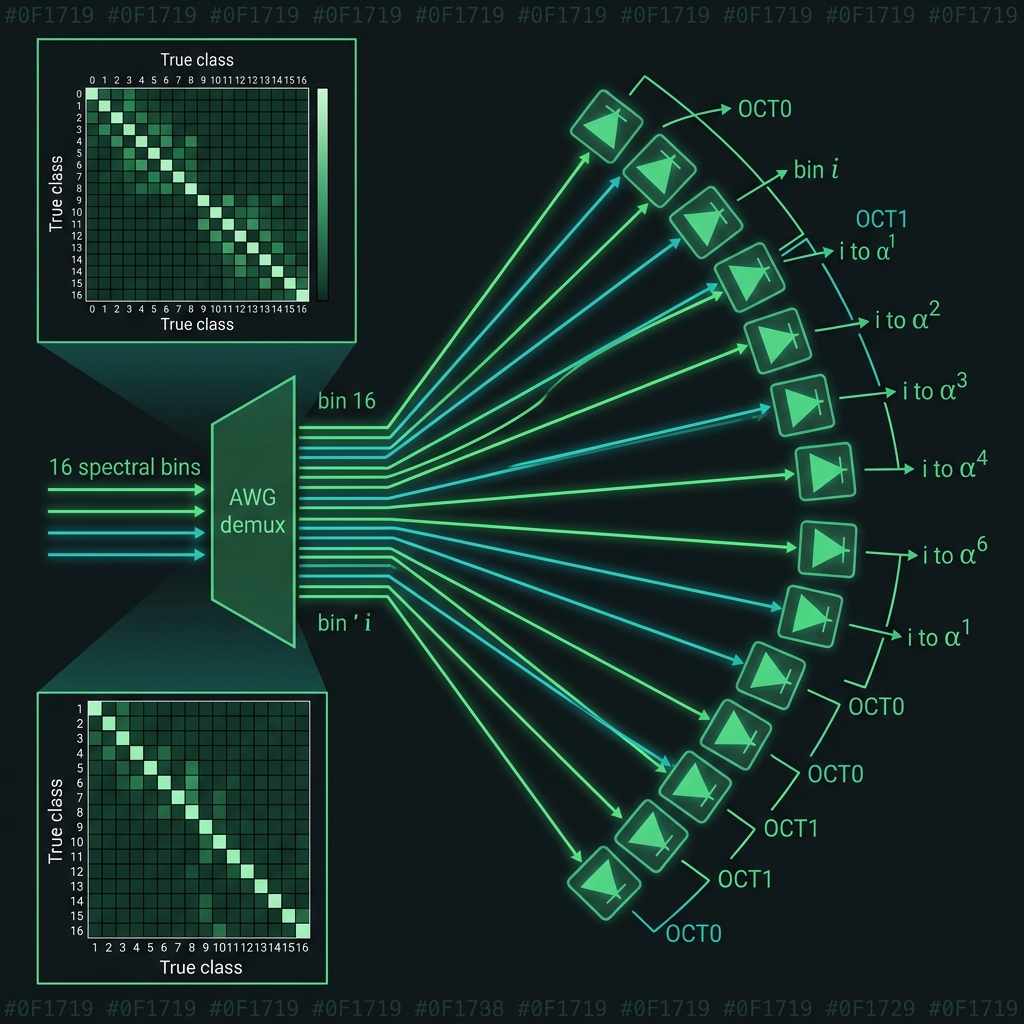 Figure 7
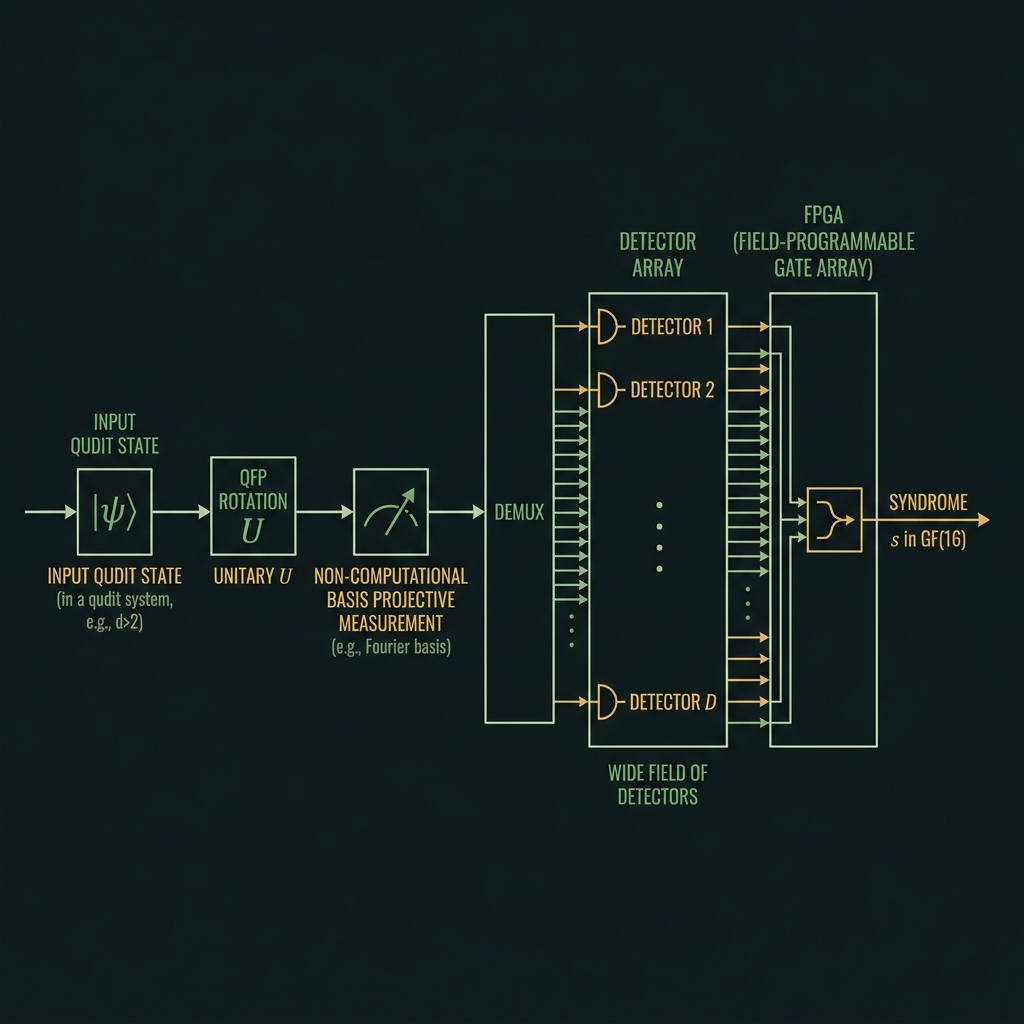 Figure 8
240 phase relationships on 50 GHz grid
Calibration complexity scales O(d²); GALAXY is still feasible on Kintex-7 BRAM.
N_pairs = d·(d−1) = 16·15 = 240 directed pairwise phase relationships φ_{ij}
Each relationship is relative phase required for F₁₆, GFMUL convolution, and stabilizer QFP rotations. Errors map to field-element phase slips, not anonymous bin drift. Target residual: σ_φ ≤ 0.05 rad rms → F₁₆ fidelity ≥ 0.95.
Comb lock & octet trims
- f_ref lock — heterodyne vs GPS RF, 10 kHz
- 16 per-tooth trims — power monitor array, 1 Hz
- OCT0/OCT1 global heaters — cross-octet φ drift guard
- 2–3 OPC pump phase biases per AlGaAs cell
- 6–10 EOM IQ tables × 8 harmonics — frozen offline
Phase relationship count
| GEMINI d=2 | 2 |
| SOLAR d=10 | 90 |
| GALAXY d=16 | 240 |
| TETRIS d=32 | 992 |
| NOVA d=64 | 4032 |
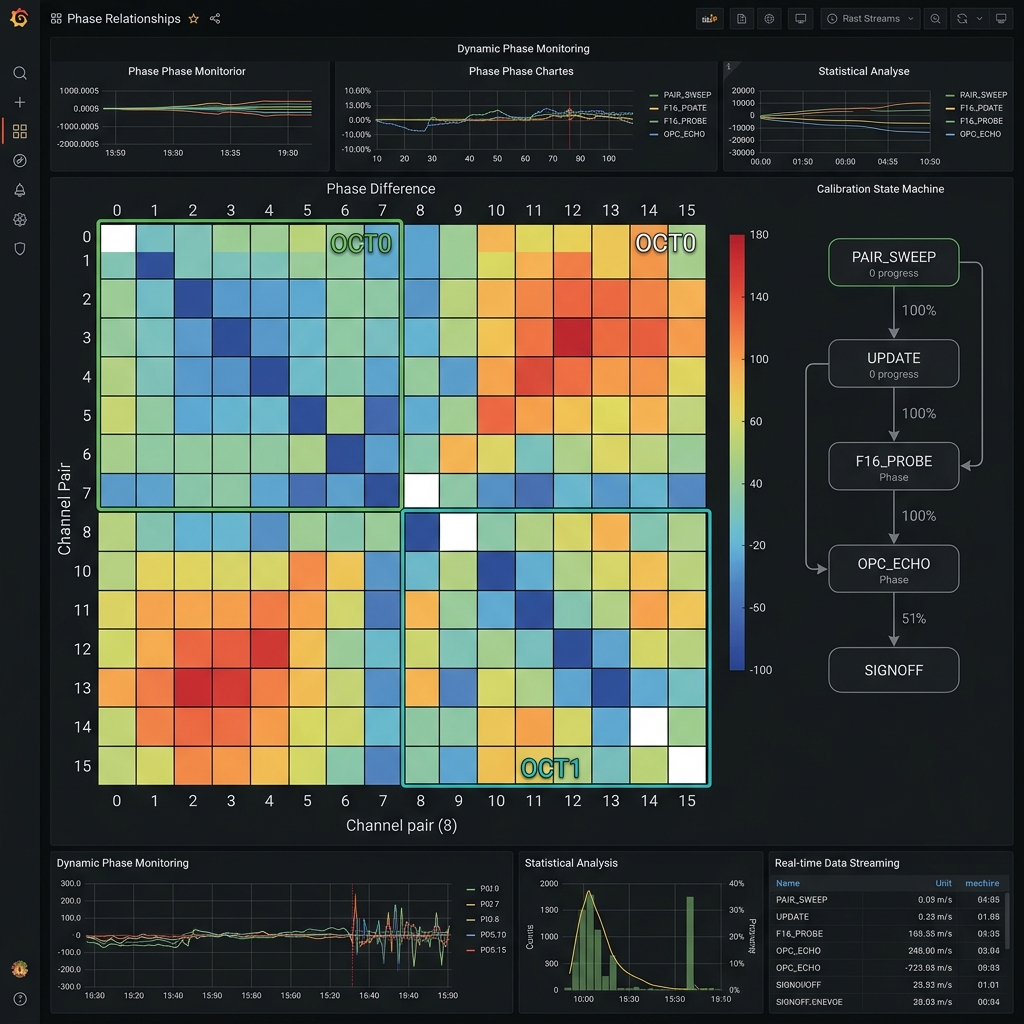 Figure 9
Distributed OPC & the canonical prototype recipe
GALAXY rehearses Region II hardware while staying Region I in the Q-metric.
Distributed FWM-OPC
AlGaAs cells · comb-derived pumps · phase pre-layerω_idler = 2ω_pump − ω_signal
→2–3 distributed cells along QFP bus; γ_eff 10–40 W⁻¹m⁻¹; pump detuning 7.4 THz Raman-null. Pumps derived from same 16-line microcomb — phase-locked conjugation reference [G45].
Insert every 6–8 QFP sandwiches. Steady-state visibility V_∞ ≈ 0.94 with M=6 stages, σ=0.08 rad, η=2% [model].
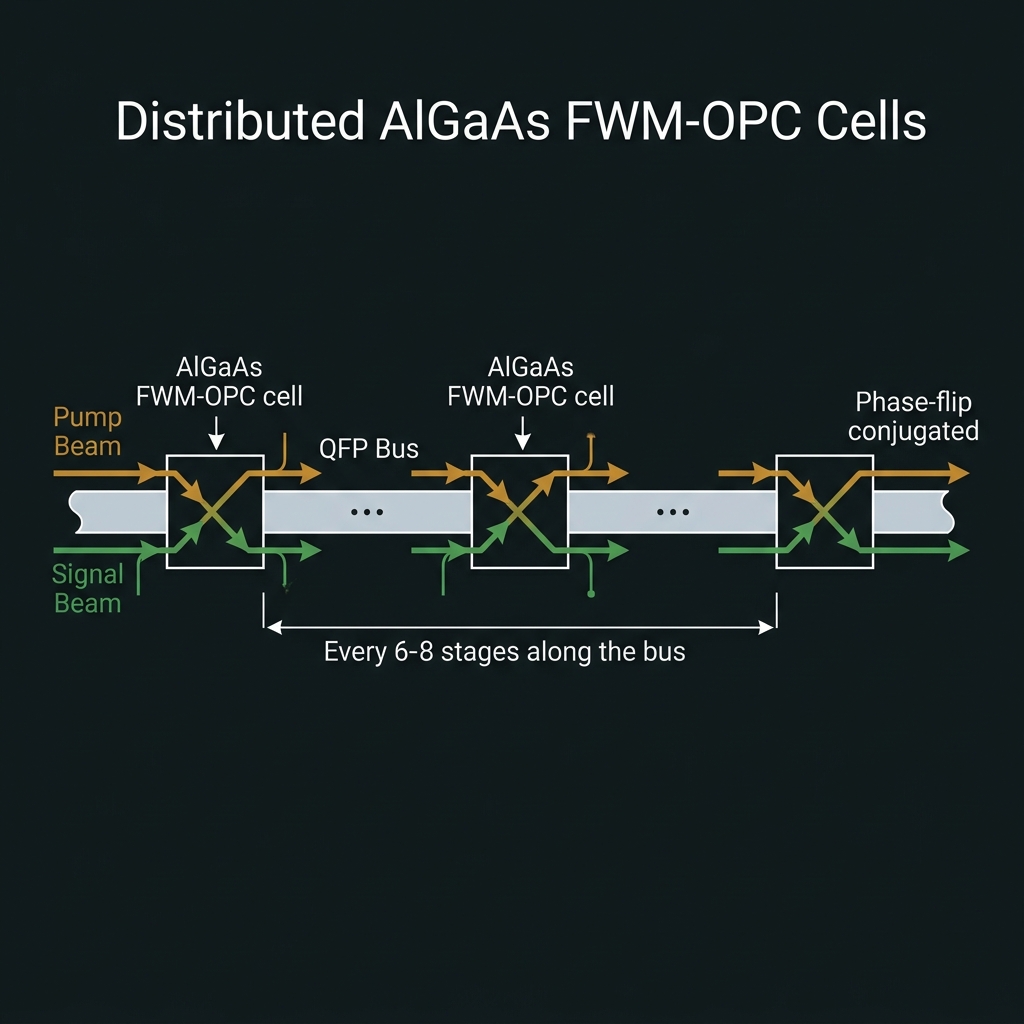
Optional squeeze at encoding boundary
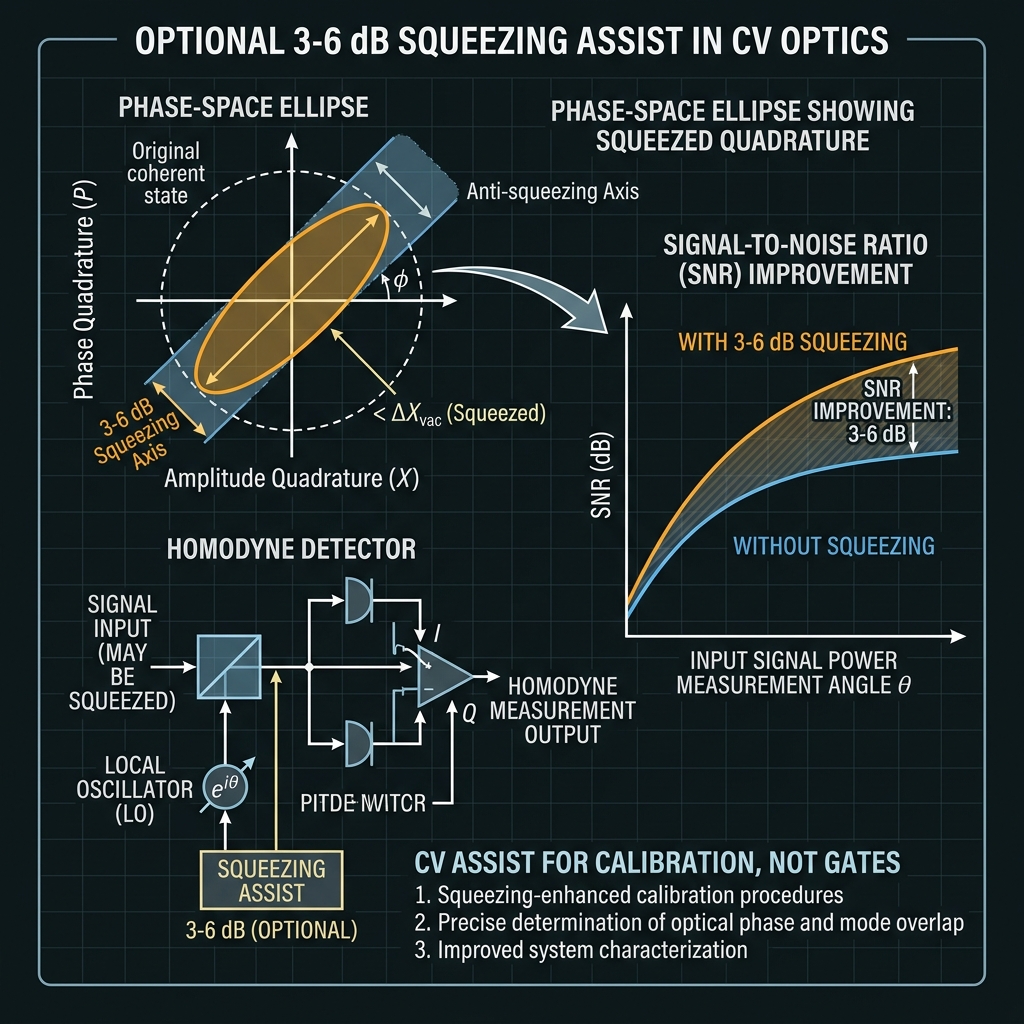
→3–6 dB squeezing (10–25% variance reduction) improves homodyne SNR for phase-syndrome checks and squeeze-assisted 240-pair calibration — not required for computational-basis SPAD readout.
Mechanism: AlGaAs OPO shunt or off-chip SFG v1. Low duty preserves Q < 0.2. Preview of H_CV bucket for QUASAR without activating field dynamics.
AlGaAs chosen for QUASAR rehearsal
→GEMINI/NOVA docs emphasize As₂S₃ chalcogenide overlay. GALAXY prototype deliberately trials AlGaAs for III-V heterogeneous nonlinear — foundry-accessible, strong χ⁽³⁾. Production NOVA may reunify on As₂S₃; both paths [designed/target] until T9.
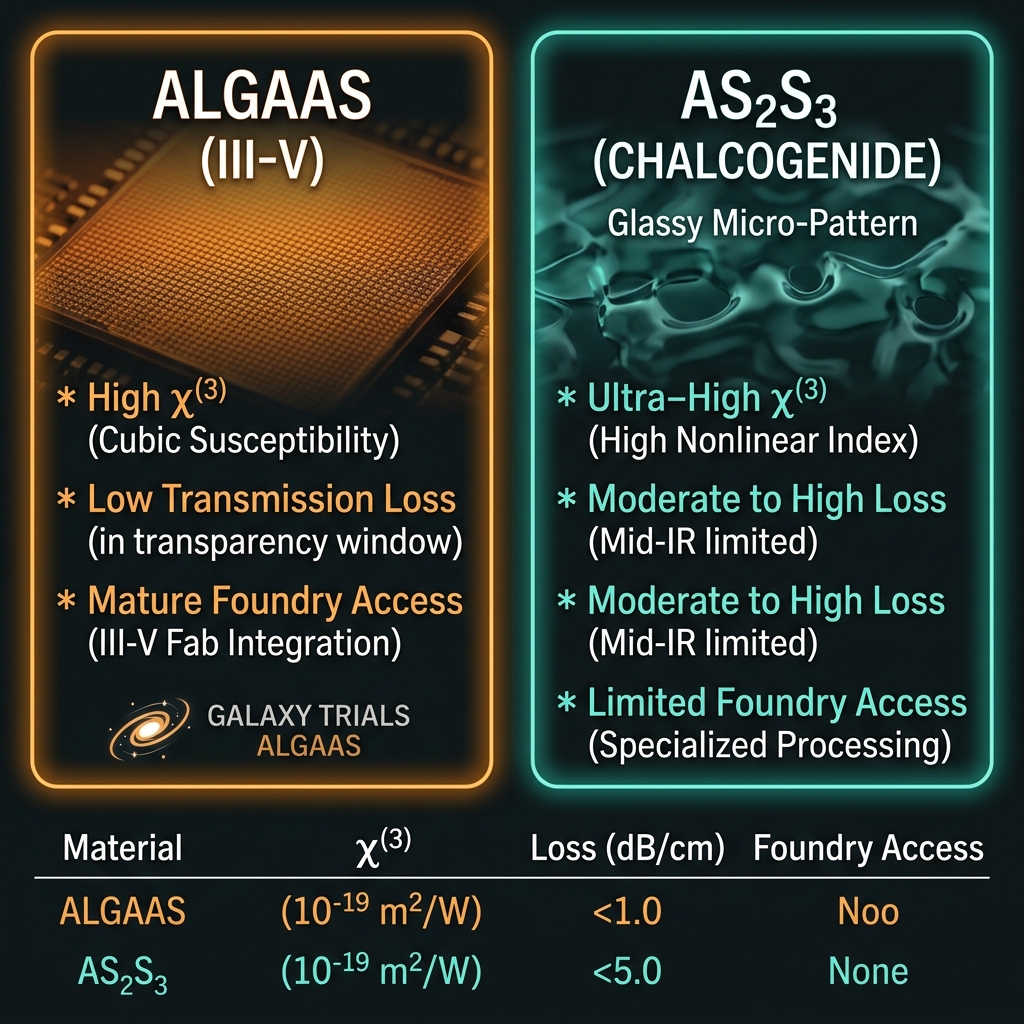
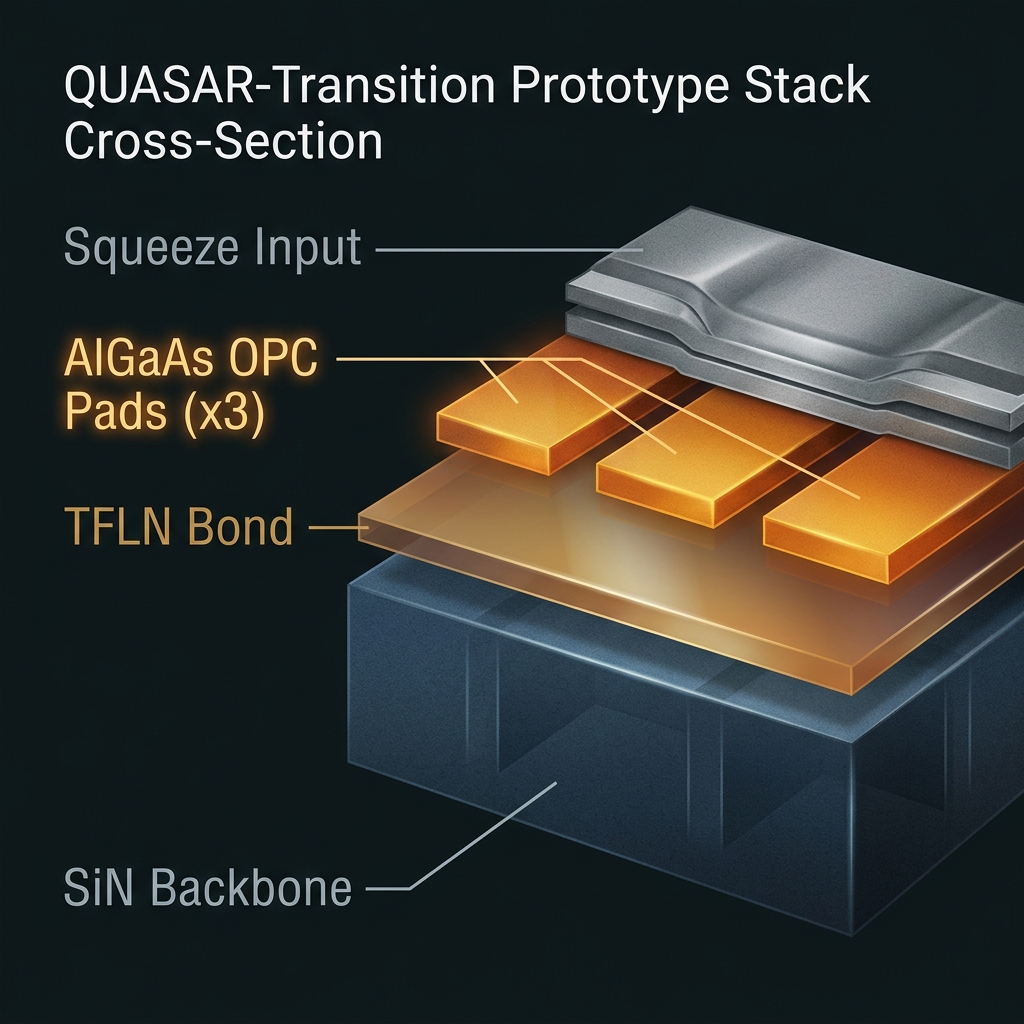 Figure 10
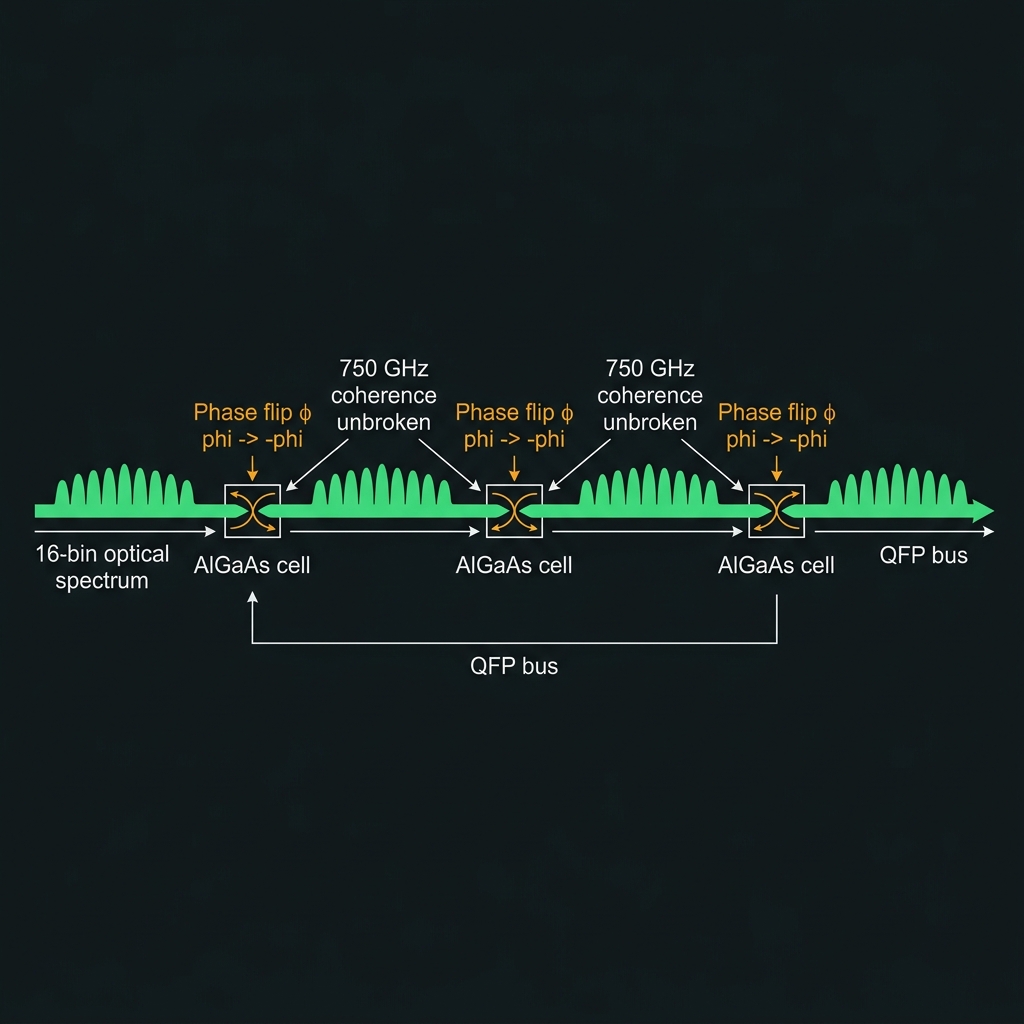 Figure 11
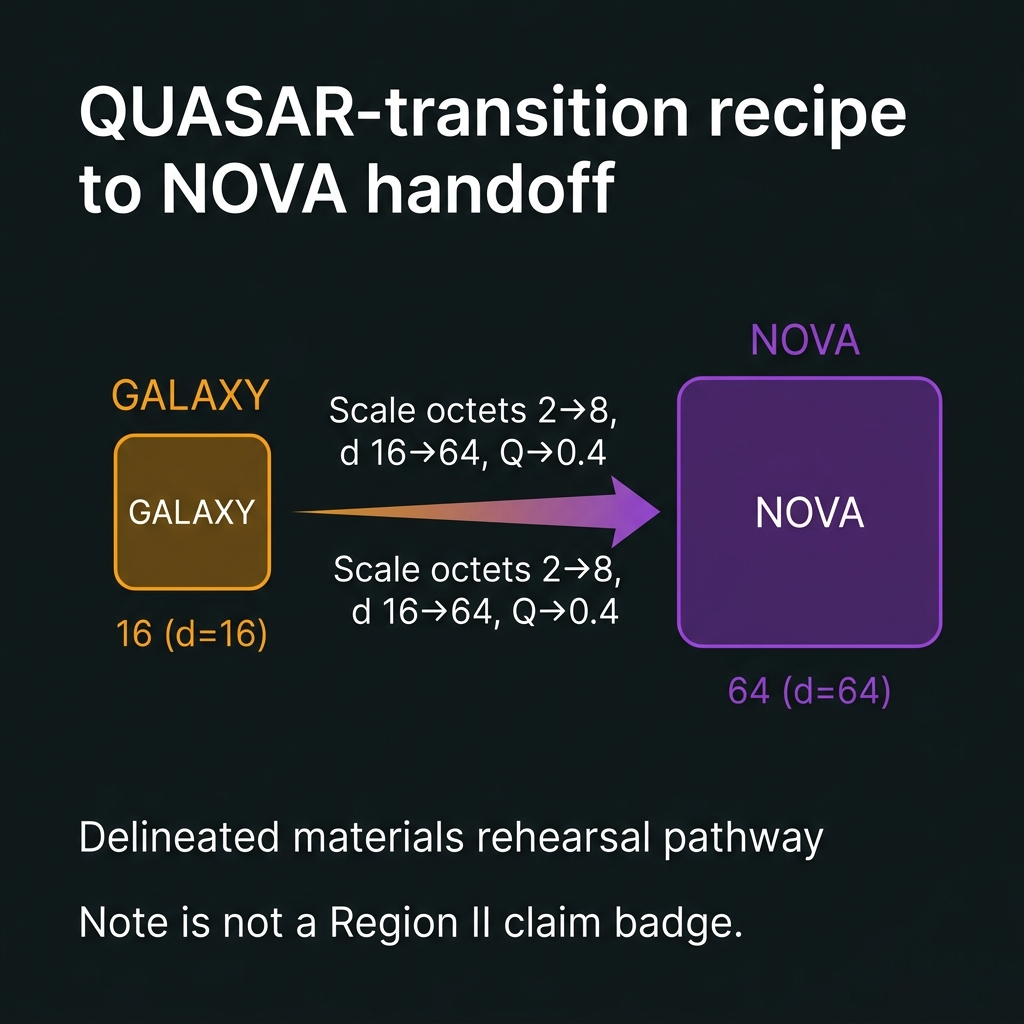 Figure 12
First field-native classical + quantum ECC
RS/BCH and X₁₆/Z₁₆ stabilizers share the native GF(16) symbol field.
RS(15,11) default
n=15 symbols, k=11 message, t=2 errors or 4 erasures. Syndromes S_j ∈ GF(16). Photonic RSENC via GFMUL chain; FPGA Berlekamp–Massey decode; RSFIX via FAU XOR.
Erasure-first: heralded photon loss → known bin position → RS gains 2× vs error-only.
X₁₆ / Z₁₆ stabilizers
15 X-type + 15 Z-type generators per qudit — X₁₆(α^ℓ), Z₁₆(β) with β, α^ℓ ∈ GF(16)*. Syndrome extraction: QFP U_k → 16-ch demux → s ∈ GF(16) → CORRECT within ~11.2 ns.
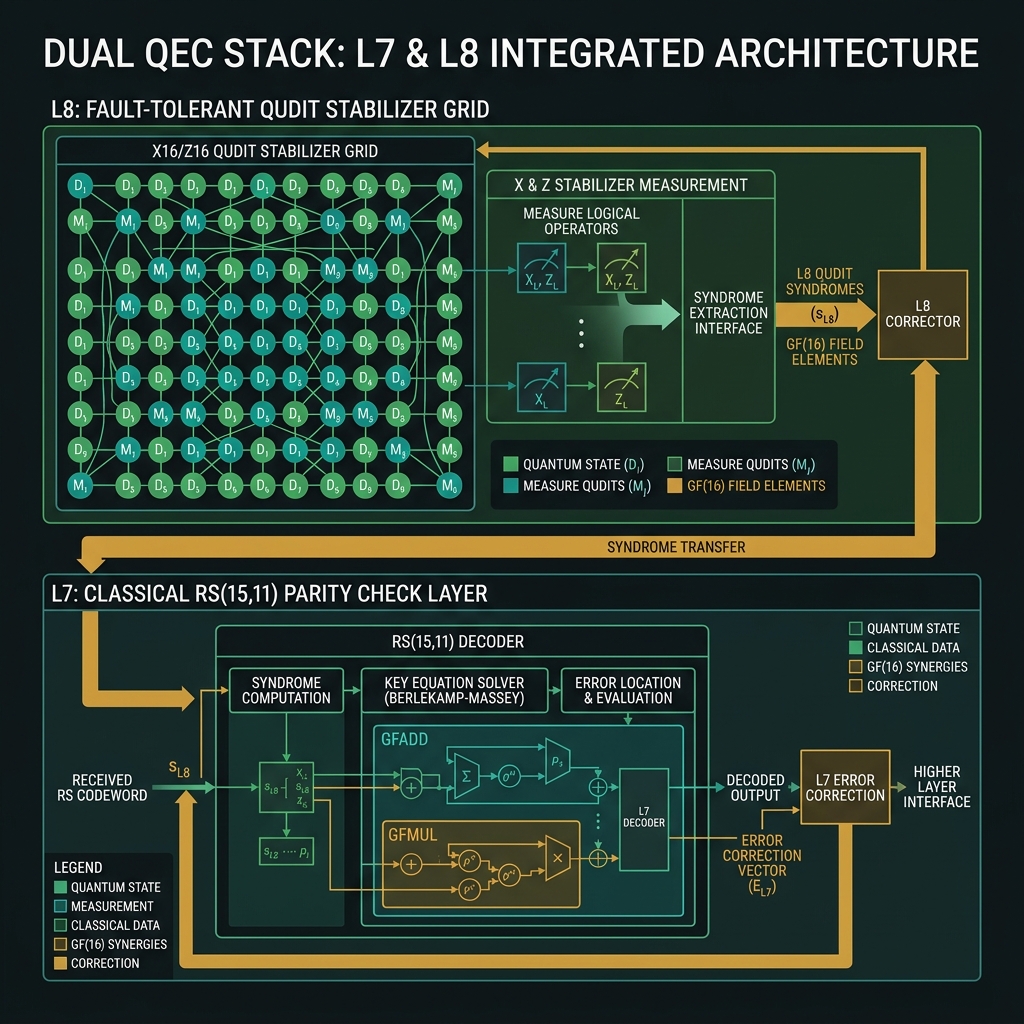 Figure 13
First true GF-based application stack
Field-native pilots for coding theory, crypto, and NOVA bring-up validation.
Pilot workloads
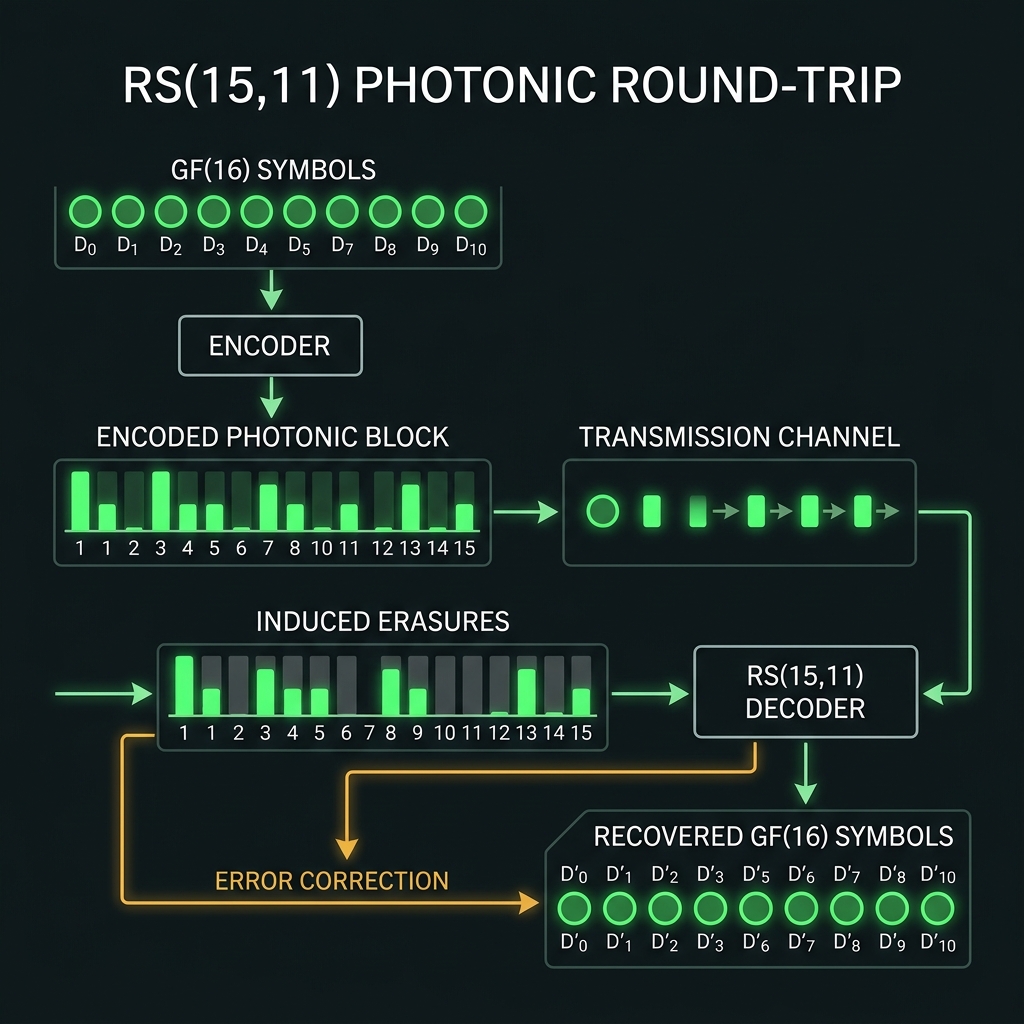
RS · GFMUL · stabilizer · field-ISA validationRS(15,11) end-to-end round-trip
→Encode 11 symbols → transmit 15-bin photon block → induce erasures or phase slips → decode. First on-chip photonic RS round-trip milestone [roadmap]. Interop with Magma/Sage — same polynomial x⁴+x+1.
Field-ISA microcode validation
→GFMUL truth table (225 nonzero products); RS syndrome match FPGA golden; stabilizer commute tableau; OPC on/off F₁₆ delta < 5%. Validates microcode before GF(64) opcode explosion at NOVA.
Decimal I/O via G04 transcoder at API boundary only — SOLAR remains decimal-native; GALAXY is field-native.
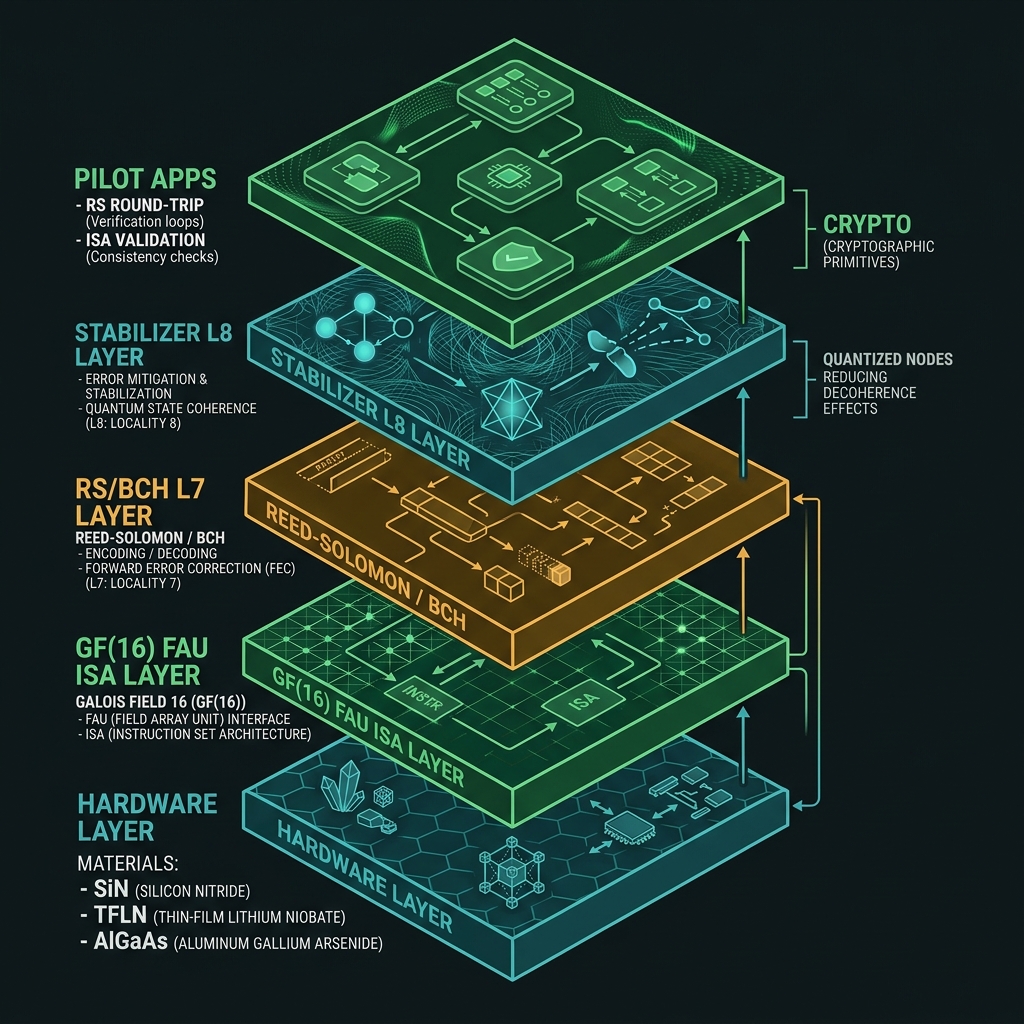
Publishable framing: Photonic qudit system of dimension d=16 implemented in frequency-bin synthetic spectral space with OPC-assisted CV stabilization and GF(2⁴) algebraic control layers — first true GF-based system in STAR-PHASER lineup. Throughput sketch [model]: ~4 Mb/s symbolic per spatial mode at pilot rates — not a product claim.
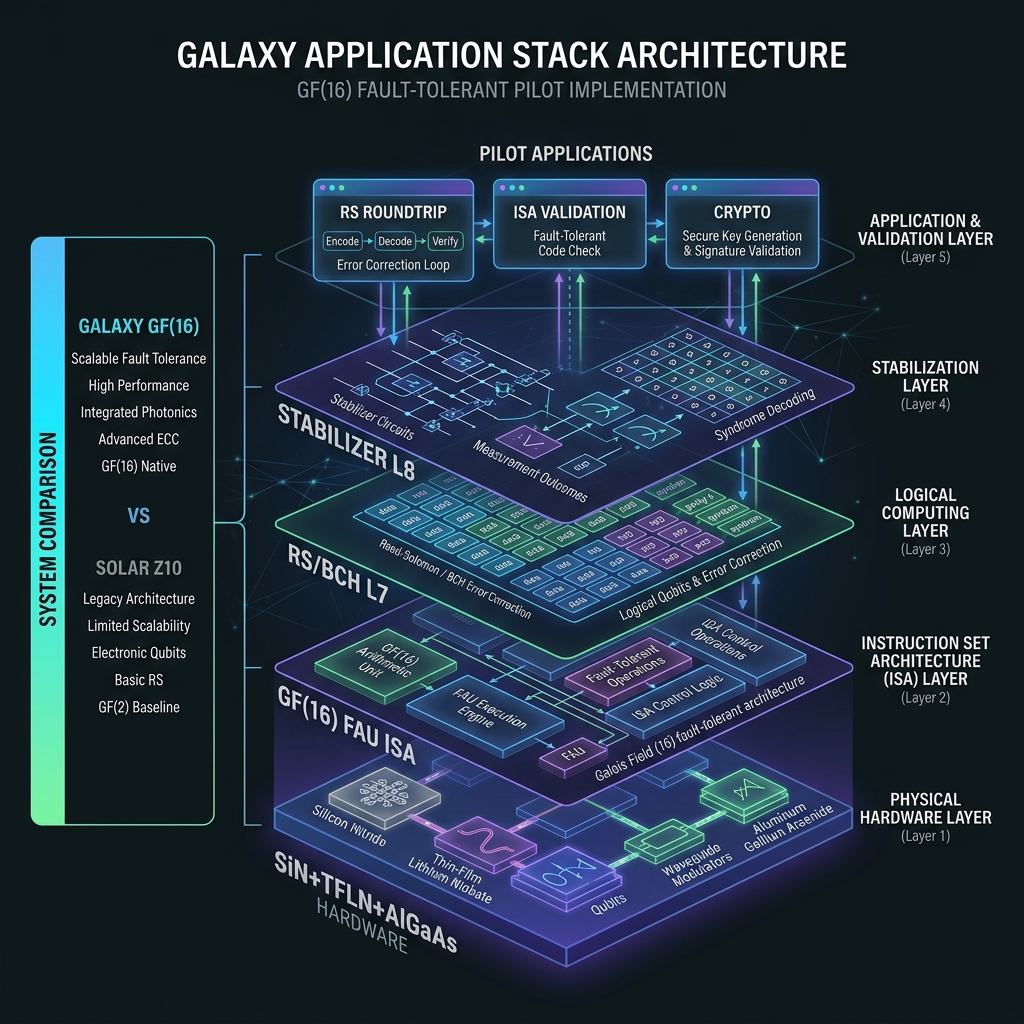 Figure 14
Bill of materials + control stack
Every component in the GALAXY d=16 system — first frequency-bin chip on the QUASAR-transition path — with verified vendor part numbers.
GALAXY adds AlGaAs OPC + TW-EOM to the GEMINI baseline
Phase A — FEOL: LIGENTEC AN800. SiN microcomb ring, AWG, shaper banks, routing. Same 200 mm X-FAB Erfurt line.
Phase B — TFLN + AlGaAs bond: QLT. TW-EOM for 8-harmonic RF bus. X-Celeprint MTP for AlGaAs OPC coupons.
Phase C — BEOL: As₂S₃ alternative OPC path. Arsenic-isolated cleanroom.
Phase D — Assembly: 18-ch Aurea SPAD module, fiber array, hermetic package.
QUASAR-transition prototype
Comb: 16-line microcomb @ 50 GHz (750 GHz span) vs GEMINI's path encoding.
OPC material: AlGaAs (γ_eff 10–40 W⁻¹m⁻¹) primary, As₂S₃ fallback — vs GEMINI As₂S₃ only.
Readout: 18-ch SPAD for single-shot GF(16) read vs GEMINI's 12-ch.
Squeezing: 3–6 dB optional at encoding boundary (new for GALAXY).
LUV → QIL → FPGA → GALAXY photonic chip
.luv source → luvc build → QIL IR 0.1.0 · run_freqbin_shot (gate-only path)
dac.voltages[40] → 16 per-tooth trims + OCT globals + OPC pump biasqfp_schedule[] → GF(16) frequency-bin unitary programsshot_contract → 18-ch SPAD pattern + comb_lock gate
AlGaAs OPC cells ×2–3 · Raman-null pump detuning 7.4 THz
From GALAXY to the full ladder
GALAXY is Rung 2 on the encoding progression. See the GF(64) roadmap, today's dual-rail platform, and manufacturing path.